
![]() |
![]() |
|
|
|
|
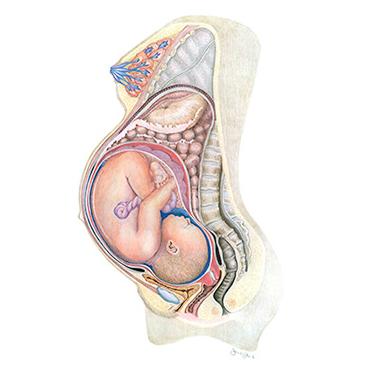
Picture and Explanation of How Your Body and Baby are Growing and Developing at 20 Weeks Pregnant
The enlargement of the uterus during this week is greatest at the site of the placental attachment (usually on the front or back wall), so the uterus has an asymmetrical bulge. The wall of the uterus, which lengthens and thickens early in pregnancy, stretches as the fetus grows, and becomes thinner now, only 3 to 5 millimeters thick. The bladder ascends but not as much as the uterus, which straightens as it ascends. Your ascending uterus rests against the lower portion of the front of the abdominal wall, causing it to bulge forward noticeably by your 20th week. The amount of the bulge is influenced by the tone of the abdominal muscles. If they are firm, the uterus may be pressed against the spinal column, and there will be no noticeable bulge; if they are weak, the pressure of the uterus against the interior wall produces a sizeable bulge. The position of the uterus during this week explains why you may feel more comfortable at this stage than earlier in your pregnancy. Pressure within the pelvic cavity, which during the earlier weeks may cause weariness and frequent urination, is relieved when the uterus ascends into the abdominal cavity. Most recent page update: 11/7/2007
© 2013 Childbirth Connection. All rights reserved.
Childbirth Connection is a national not-for-profit organization founded in 1918 as Maternity Center Association. Our mission is to improve the quality and value of maternity care through consumer engagement and health system transformation. Childbirth Connection promotes safe, effective and satisfying evidence-based maternity care and is a voice for the needs and interests of childbearing families. |
News and Features
Listening to MothersSM III is the third national
survey exploring women’s experiences in pregnancy and childbirth.
Commissioned by Childbirth Connection, conducted by Harris Interactive, and
funded by the W.K. Kellogg Foundation, the survey polled 2,400 women who gave
birth in U.S. hospitals from 2011 to 2012. Results show that medically
intensive experiences are typical, and evidence-based practices are
underutilized. Childbearing women need better support and knowledge to
navigate their maternity care.
Access the full report and supplementary materials ![]() New Report: Maternity Care and Liability Go to report and supporting materials ![]() New Report: The Cost of Having a Baby in the United States Go to report and supporting materials ![]() New Cesarean Resources: Go to Best Evidence Report ![]() Go to web pages and booklet for women ![]()
For 95 years, Childbirth Connection has been dedicated to improving the
quality and value of maternity care for all women and their families. Learn
more about our rich history through our interactive
timeline and give
$95 for 95 in honor of
our 95th birthday.
Childbirth Connection works to ensure that all women and babies get the best
possible maternity care. We have the collective vision and we know how to get
there, but we can't do it alone. Join the transformation
today.
The Transforming
Maternity Care website focuses on maternity care
system improvements designed to engage diverse stakeholders in quality
improvement efforts. The site offers full access to the landmark reports 2020 Vision and
Blueprint for
Action, features a Blog, and other
resources such as an Action Center, a
database of
quality improvement projects, an interactive data
center, and many more tools
for advocates and stakeholders.
Help Transform Maternity Care! |